
Are you one of 56% of perimenopausal women that aren’t sleeping through the night? Here’s what’s actually happening in your body — and the Sleep guide I just finished about it.
If you’ve been waking up at three in the morning, heart racing, mind racing, wondering what’s wrong with me — then the TikTok doom scroll starts, and before you know it another night of 4-5 hours of sleep is in the books — I want you to hear and internalize this: nothing is wrong with you. 56% of perimenopausal women sleep less than seven hours on a typical night, the highest percentage of any menopausal group. Clinically significant insomnia roughly doubles during the menopause transition. 69% of midlife women report some form of sleep disturbance.
I know — “so you’re telling me this is going to go from bad to worse!” Maybe. But I want you to remember that YOU ARE NOT A STATISTIC. You have the power and the ability to equip yourself with the knowledge and tools to rise above this brief time in life. This is not a personal failing. It’s close to the norm, and it follows the menopause transition closely enough that national data shows the pattern. We are now prime targets for the sleep industry and every other industry that thinks it can capitalize on us. But seriously, who wouldn’t pay to have better sleep? A $65 billion industry is selling us pills and gadgets “hoping” to help. I’ve fallen prey to some of this marketing more than once. The problem is most medications sedate you. Sedation is not the same as restorative sleep.
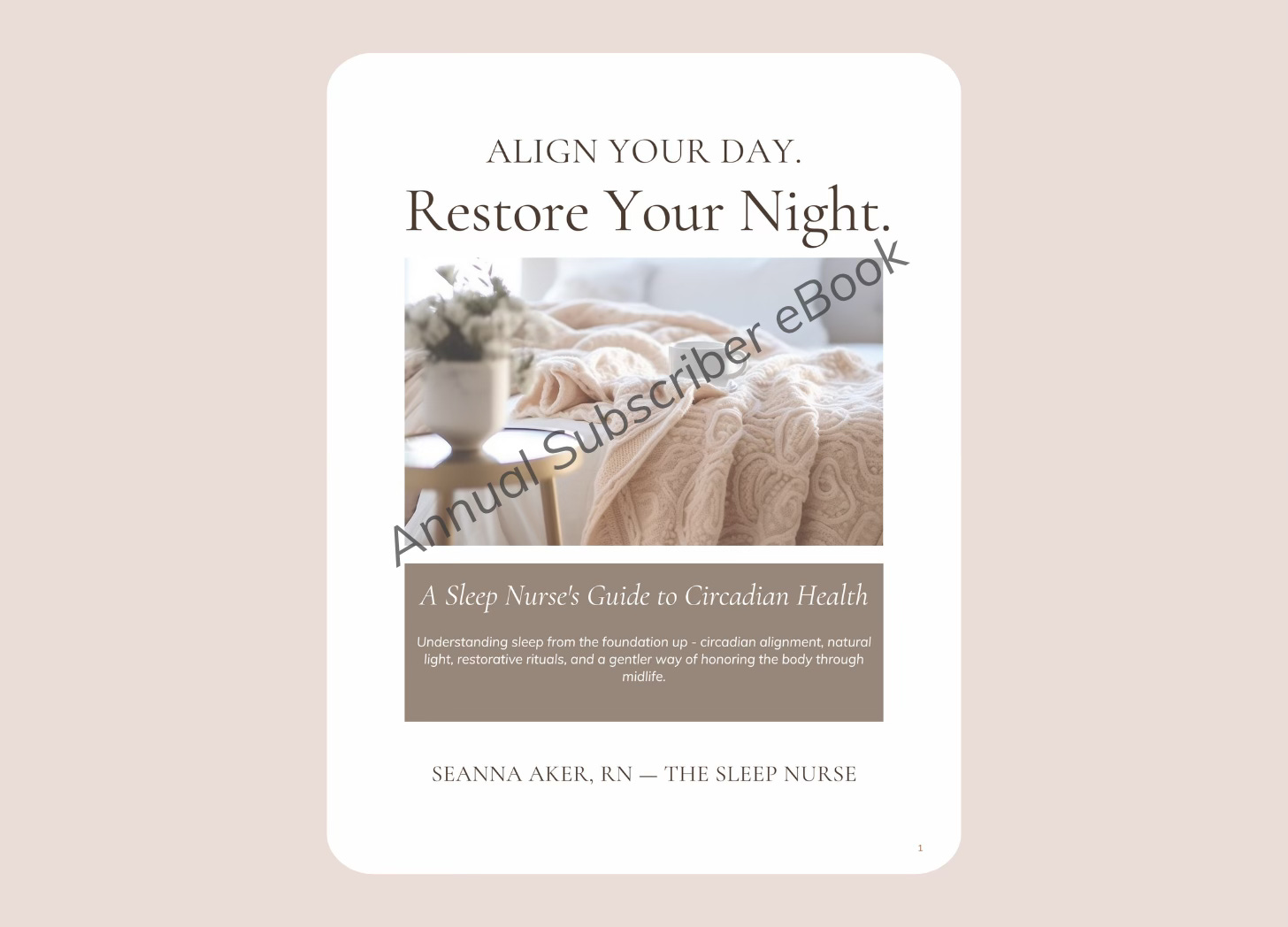
This distinction is exactly where I start in my 37-page Sleep Guide I’ve been working on for months and finally finished: Align Your Day, Restore Your Night — A Sleep Nurse’s Guide to Circadian Health. It’s ready to be sent out to my annual subscribers. Thank you for your support and for trusting me as your sleep health guide.
If you’ve read Macros for Midlife Sleep here, the goal was to make you familiar with some of the key components in this guide — most importantly, shedding light on the question “why aren’t the things I’m currently doing working?” This guide is the foundation of the sleep macros and my proprietary sleep coaching program. Out of respect for my annual paid subscribers, I’m only going to give a broad overview here. But I want you to feel the passion I have to help midlife women obtain meaningful, restorative sleep. Let’s jump into it.
What question should I be asking?
Most women wonder “why can’t I sleep anymore.” I reframe this question in Part One:
“It’s not ‘why can’t I sleep anymore,’ it’s ‘what changed in my body’s signaling, and what levers are in my control that will cause meaningful change.’”
In the guide, I give you the knowledge and tools to pull those levers.
One night. Seventy percent.
As a nurse, this is the stat that stops me every time I re-read it: researchers restricted healthy adults to just 4 hours of sleep for a single night. The result? Natural killer (NK) cell activity — a key part of how your immune system protects you from viruses, disease, and more — dropped by roughly 70%. One night. That’s how fast your body’s defenses are damaged by a poor night of sleep.
I unpack the mechanism behind this in Part Two, along with something I call “clock chaos” — what happens when your master clock stops receiving a clear signal, and how that translates to waking at 3am and that afternoon energy slump.
Where it started for me
I was the kid who was afraid of the dark and slept with the light on. Then I became a nurse and worked night shift for years — almost two decades — which amplified everything. I leaned on medication just to get any rest at all. What I didn’t understand then was that sedated sleep and restorative sleep are not the same thing. I share my story in the guide, because I want you to know the fixes here didn’t come from a textbook first. They came from me studying and researching what the nursing textbooks left out.
What’s inside
Part One: The Truth About Sleep — Understanding sleep in midlife, and finding strength in the fact that you are not alone in this. Self-reflection to understand your sleep biases and current sleep patterns.
Part Two: Understanding Your Circadian Rhythm — Here we dive into some science. It’s okay, I’m your guide and partner in this — I make it simple to understand. You’ll learn about your master clock (SCN), the biology of light, and how all of this changes in midlife.
Part Three: Putting It Into Practice — Here I share the real-life application, starting with the Wake-Up Sleep Calculator and a 7-Day Sleep Check List, so you can start applying what you’ve learned on your terms.
If you’re an annual member
It’s already waiting for you! Read it slowly, in whatever order pulls you first.
If you’re not yet
This is exactly the kind of content I create for annual members: the deeper “why,” not just another quick list of tips. Upgrade to annual and it’s yours today, along with the rest of the members’ archive as it grows.
If you’re just finding your way to The Sleep Nurse — subscribe free to keep getting posts like Macros for Midlife Sleep. I’ll always teach the foundations there. This guide is simply where I go deeper.
Align your day. Restore your night.

This post reflects an educational, general-audience summary of sleep science. It is not a substitute for individualized medical advice.
References
Vahratian, Anjel. “Sleep Duration and Quality Among Women Aged 40–59, by Menopausal Status.” NCHS Data Brief No. 286, National Center for Health Statistics, Sept. 2017. https://www.cdc.gov/nchs/products/databriefs/db286.htm
“Sleep Disturbance Associated with the Menopause.” Menopause, 2024. https://journals.lww.com/menopausejournal/fulltext/10.1097/gme.0000000000002386
Roberts, Nicole F. “Despite $65 Billion A Year Sleep Aid Market, Americans Remain Sleep Deprived.” Forbes, 20 Mar. 2022.
Irwin, Michael, et al. “Partial Sleep Deprivation Reduces Natural Killer Cell Activity in Humans.” Psychosomatic Medicine, 1994.